
Most corporate team building runs into the same three problems: it is hard to schedule, it does not scale to the size of the group, and it feels forced. A City Fable mystery game is built to avoid all three. It is a self-guided walking mystery your team solves together on real streets, with no host, no fixed start time, and one licence per team of up to six.
This guide covers the practical side: why the format works for a work group, when to run it, who it suits, how long it takes, and how an organiser actually sets it up.
Why a mystery game works for teams
The usual options each have a catch. A harbour cruise or kayak is scenic but weather-dependent and expensive per head. A cooking or tasting class is inclusive but keeps everyone seated indoors. An escape room is fun for a few people, but the fixed time slot and room cap make a larger group awkward to split.
A self-guided mystery trail removes the two headaches that sink most team activities: scheduling and group size. There is no slot to book, so a shifting calendar costs you nothing, and the per-team licensing means a big group simply becomes several teams racing the same trail.
It also gets everyone walking and talking without the forced-fun feeling. Nobody is put on the spot. The puzzles do the bonding, because solving a story together is a shared goal rather than an icebreaker someone has to perform.
When to run it
The no-fixed-start-time design makes the format unusually flexible, so it fits several slots in the work calendar:
- A team offsite or away day. Use it as the centrepiece of a half-day, with a coffee briefing before and a lunch debrief after.
- After work. The team finishes up, gathers, and sets off whenever everyone has arrived. No slot to make, no host waiting, and you can end at a bar if you still want the social part.
- Onboarding or a hybrid get-together. When a distributed team meets in person, a shared task gives people a reason to talk that is not small talk.
Because there is no deposit and no booked slot, a rained-out plan simply moves to next week at no cost. That takes the pressure off the organiser entirely.
Who it suits, and team size
The format is licensed per team of up to six players, which is what lets it scale by addition rather than by squeezing everyone into one venue:
- Small team (up to 6). One licence, one team. The simplest possible setup.
- Mid-size team (10 to 20). Split into two to four teams of up to six. Send them off a few minutes apart and let them race.
- Large group (20+). Keep adding teams. Twenty-four people is four teams; the experience does not degrade as the group grows.
Mixed fitness is fine. The walking is light and flat, and teams set their own pace, so nobody is rushed and nobody is left behind.
How long it takes
Plan for a half-day if you want the full social value:
- The game itself: 90 to 120 minutes of walking and solving.
- A coffee briefing beforehand: 15 to 30 minutes to gather and explain the premise.
- A lunch debrief afterwards: as long as you like. This is where the day pays off, as teams compare how they solved it and argue about the clues they missed.
If you only have an evening, the game on its own is a comfortable after-work length.
How an organiser sets it up
The appeal for whoever is running it is what the format removes:
- Buy a licence per team. One licence covers up to six players.
- Each team gets an invite code by email. No facilitator to book, no venue calendar to coordinate around.
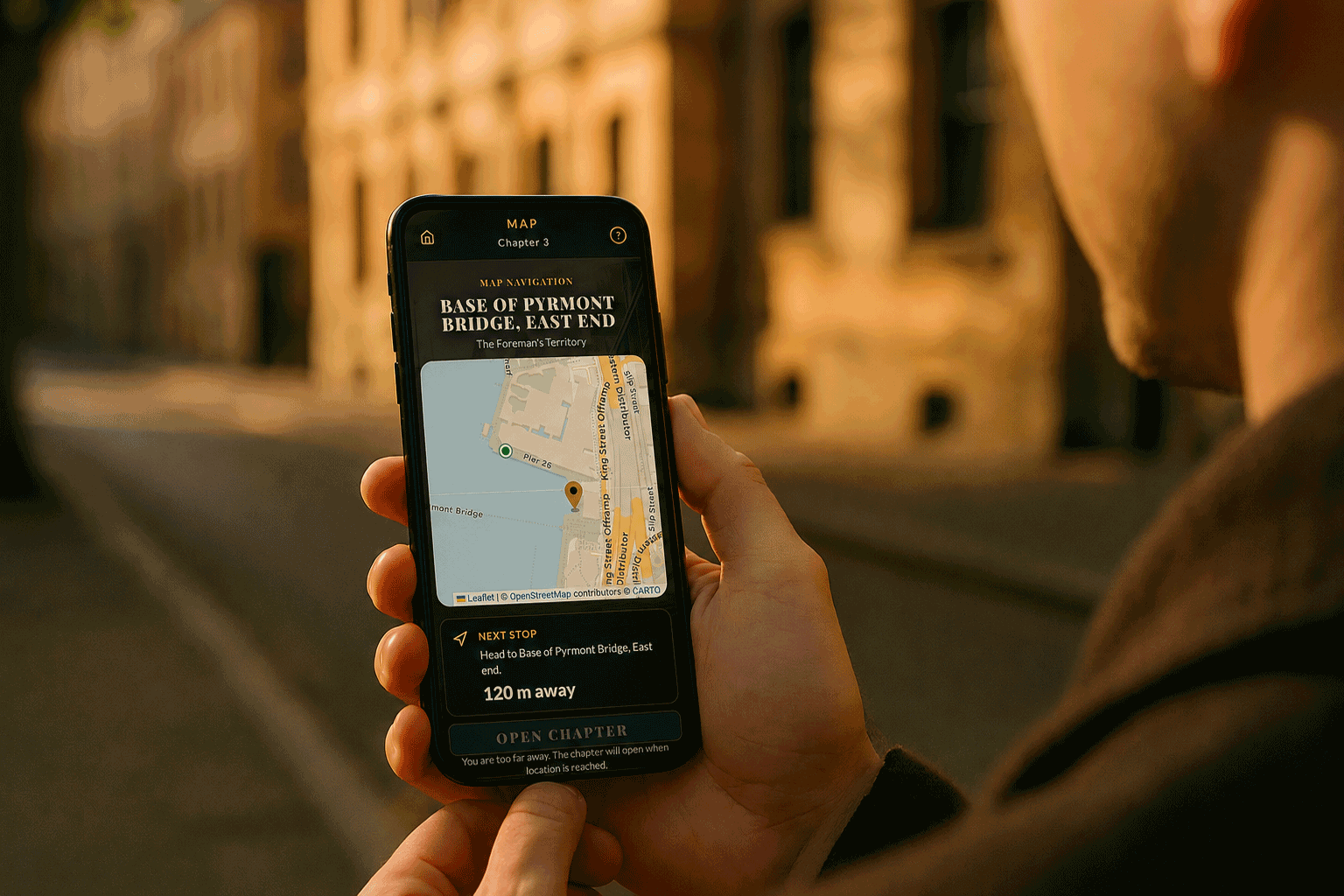
- Send teams off when ready. They redeem the code in the app and the story unlocks chapter by chapter as they reach each location.
- Compare results over lunch. A natural, low-effort debrief.
A tax receipt is issued automatically at checkout, which keeps finance happy. For group sizes, invoicing, and running several teams at once, see the team building page.
See it in practice
If you want to know what a real session looks like, our Darling Harbour and The Hungry Mile guide walks through a worked half-day itinerary on the Sydney waterfront, from the coffee briefing to lunch at the finish.